When I first met with Erin it was midday and she asked if I wanted any grits. My first reaction was to laugh because what immediately came to mind was the movie My Cousin Vinny. Just as Joe Pesci learns in the movie, I learned that people take their grits seriously.
True to her roots, Erin insists the best grits are stone ground, yet she has trouble finding them around here. Whenever she is in her hometown in Kentucky she buys bags of the good stuff to bring back up. She admits that there may be a suitable option in the area but there is something special about bringing a cherished piece of your past with you into the present.
I soon realized that she has knack for making a place home. At the Joinery, she brings homemade cakes and even takes suggestions to suit the likings of those with simpler palettes (like Tall Dave and his insistence on “just chocolate”).
Perhaps it is Erin’s nurturing nature that makes her presence so impactful. She spent twelve years as an occupational therapist in New York City, specializing in progressive neurological conditions and hospice. In apartments often lacking the accessibility features they needed, she would devise ways for patients to interface with an environment that did not fit their bodies. These “jigs”, to use a woodworking term, enabled patients to feed themselves or to get up from a chair.
Motivated by an earnest desire to help her patients while facing a challenging system of price tags and paperwork, Erin ultimately burned out. Finding ways to improve the quality of our lives is often about having the willingness to adapt to the conditions before us, including the condition of our own health. Erin realized this and decided to dive into her art, for it was something she always longed to devote more time to.
When asked about her experience during the COVID pandemic she shares simply, yet powerfully that people realized art and music are, in her words, “bread, not icing.” Creating or experiencing art has the capacity to heal. It can be a safe harbor where hope and peace of mind are restored.
It was one year ago that she moved to the area when her partner took a job as a music professor at Skidmore College. In her log home, just fifteen minutes from Saratoga Springs, she pursues art full time for the first time in her life.
We settled in with tea on the back porch and engaged in sincere conversation about life, our shared fondness for the Joinery and the people there, and the larger context of our lived experience. The tone felt in a way like two old friends catching up – or better yet, just as it was, two neighbors having tea in the afternoon.
As we spoke, I admired the romantic beauty of what once was a clearing but is now overgrown with an encouraging spotlight for wildlife to step into.
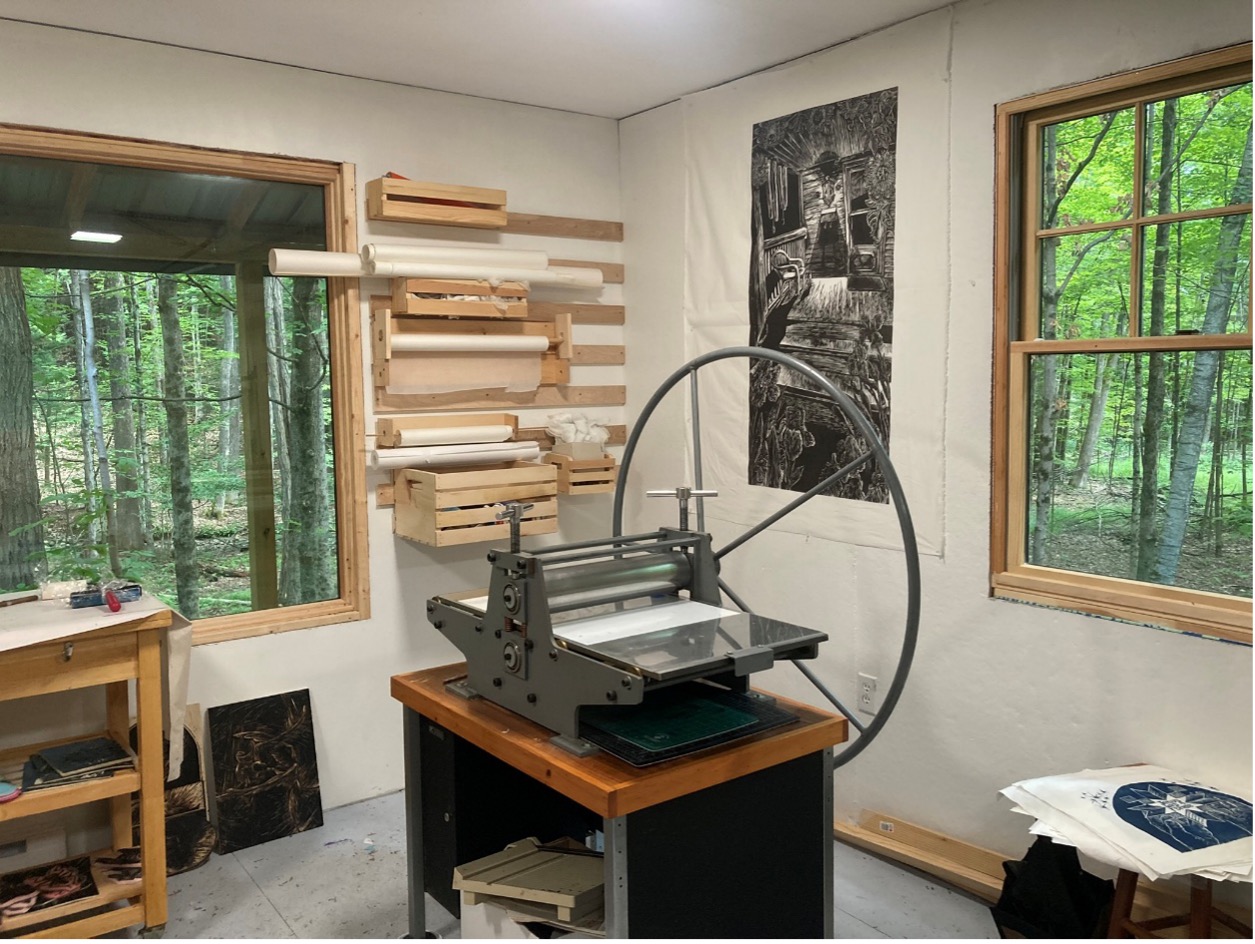
When asked how she got started making art, Erin says she has always drawn, especially nature, but it was in Providence, Rhode Island, where she first took a class in woodblock printing at the community studio AS220. No matter where she has lived, she says, she has always jumped at any community-offered creative opportunity. Erin now makes original woodblock prints using an etching press, building her own wooden frames and lantern boxes for the final product at the Joinery.
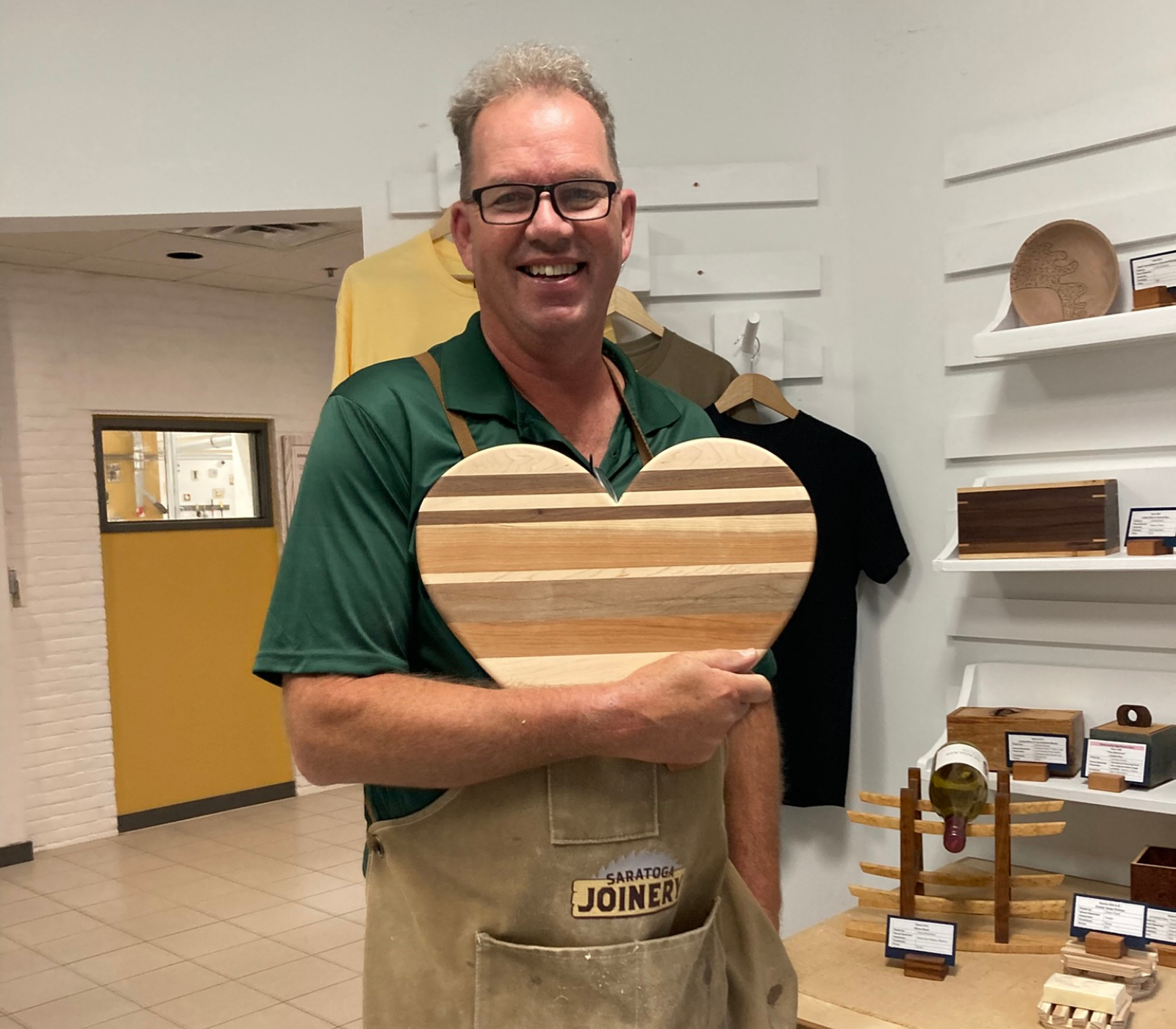
As an artist, framing can be an expensive part of showcasing or selling your work. When she first moved to Saratoga she took a frame-making class for artists at Saratoga Joinery, funded by a grant through Saratoga Arts. There she first learned how to make her own frames for her work. The connections she made have been fruitful as well. Erin now holds printmaking classes at Saratoga Arts, teaching both woodblock and screen printing this Fall, and volunteers as a shop manager as part of a membership exchange at Saratoga Joinery. She is scheduled for a “shop talk” at the Joinery in the coming months.
The Saratoga Joinery’s extensive woodshop and knowledgeable volunteers have been a great resource as Erin continues to make frames for each new print. Erin picks up one of her wall lanterns, a unique combination of framed artwork and a light fixture, to show me how it’s made. She explains how she uses splines, thin slices of wood, to strengthen a miter joint.
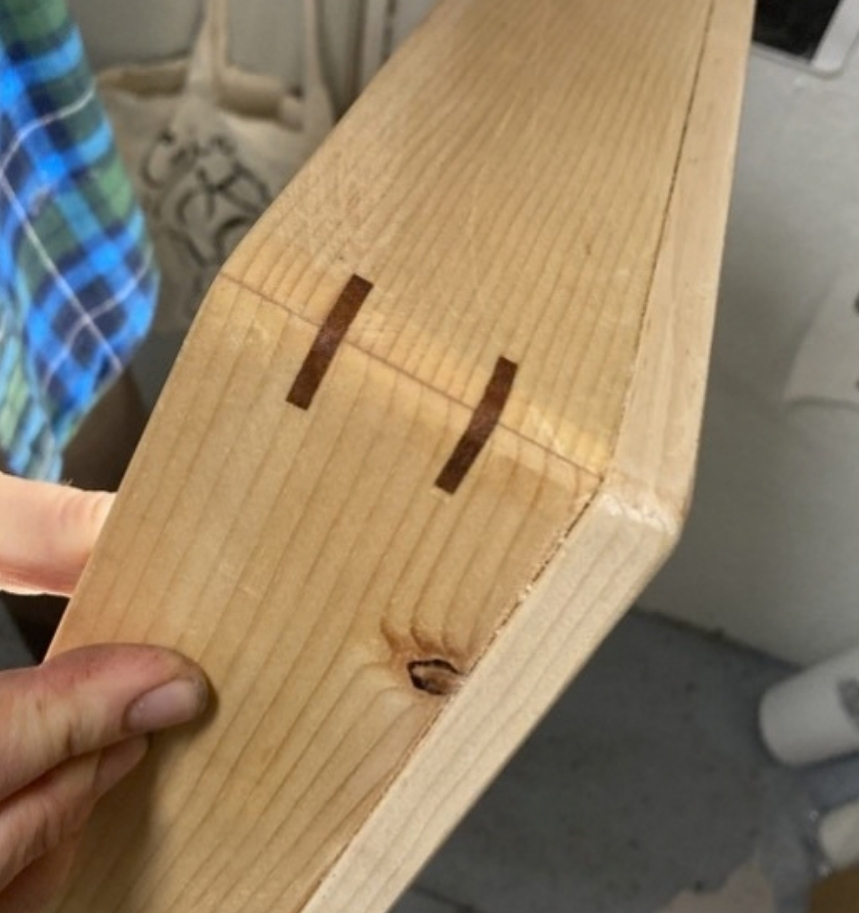
While Joinery membership provides a discount on material purchased locally at Allerdice Ace in Saratoga or Curtis Lumber in Ballston Spa, Erin likes to utilize the scrap wood bin as much as possible, finding new life in discarded material. She still goes to Suave Faire to see Bill, whom she speaks fondly of, to cut the glass for her framed prints. It is a relationship that she cherishes as another connection in a community network supporting local artists.
Sketching her initial vision with pencil on paper and transferring the final drawing to a piece of plywood is only the first step in a series of positive and negative translations. Having double-majored in college in upright bass and psychology, Erin’s interests span the distance between art and science. It seems fitting that she would take on such a technical artistic process as is this form of relief printing, which originated in Ancient China. She also creates intaglio prints, etchings on metal sheets, that, like her paper prints, can be framed for wall-hanging or used as screens in her hand-crafted wooden lanterns. Curious, I asked if she could etch sheets for a copper kitchen hood – and she said yes! The range of her process and use of material allow for her artwork to be used in a variety of ways.
Once her design is drawn on the woodblock, or “block”for short, she begins to carve out the negative space. It is a mirror image of the print, both from left-to-right and in depth. The deeper the grooves, the less it will show on the ink print. The finished block resembles a landscape of shallow to steep slopes, translating to degrees of shadow, which are perceived as depth, in the two-dimensional print.
The block is covered with a layer of ink then placed on the bed of the etching press. The substrate, whether it is paper, metal, or fabric, is laid on top. A metal cylinder, called the drum, can be moved up or down to adjust the pressure. A large wheel is turned to move the bed under the drum as it “presses” the substrate onto the carved woodblock.
Erin’s more detailed pieces are in black ink, allowing for the white of the paper, the negative space, to highlight the story. The original carvings line the walls of her studio, resembling fossils in a museum.
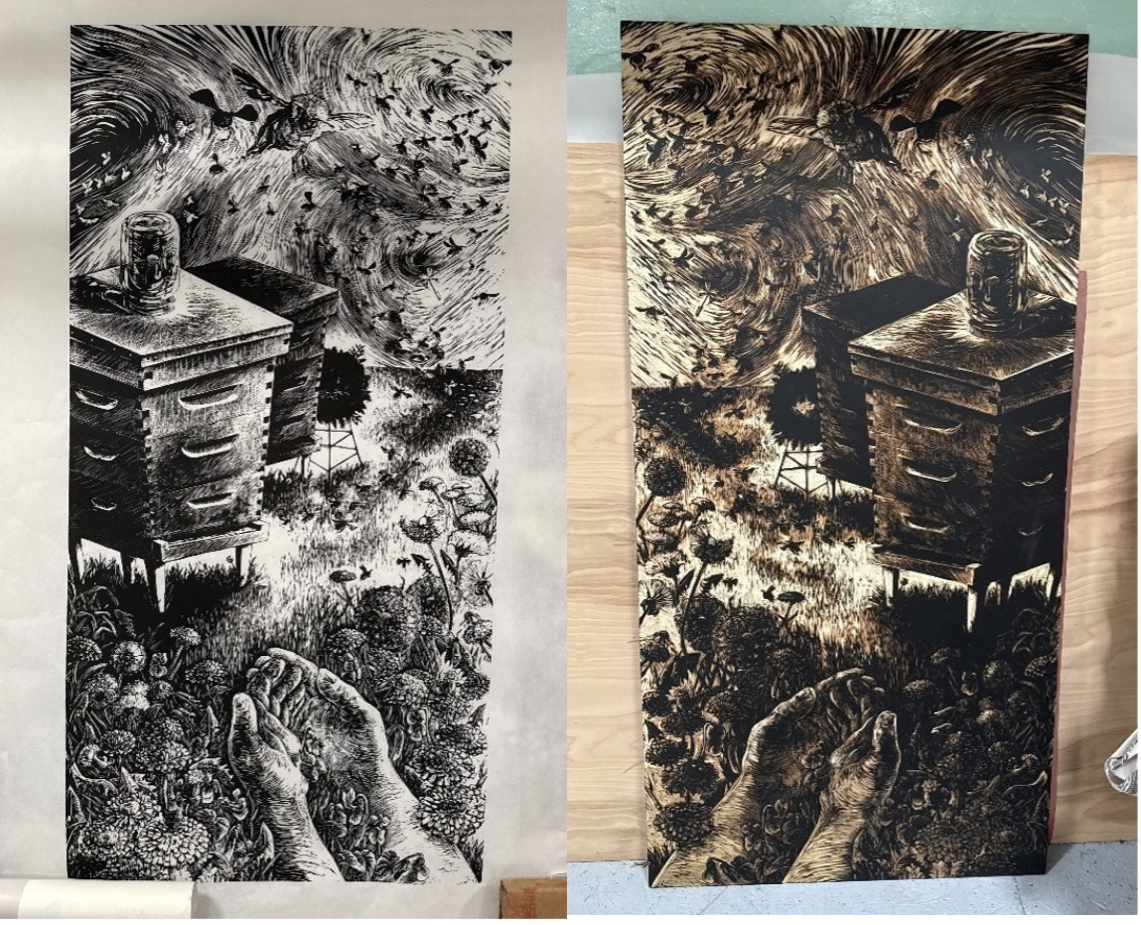
She points to a piece showing a beehive with open hands approaching the hive box. It is a reference to a Kentucky grieving custom when a beekeeper passes away someone needs to tell the bees so that they do not fly away. The patterns of the swarm resemble fingerprints in the sky.
After understanding all that goes into each print, I could really appreciate the level of detail Erin carves into her blocks and the care it must take to produce a clean image. It surely pays off. The movement and texture of her work pull your heartstrings, drawing you into very real and relatable human experiences.
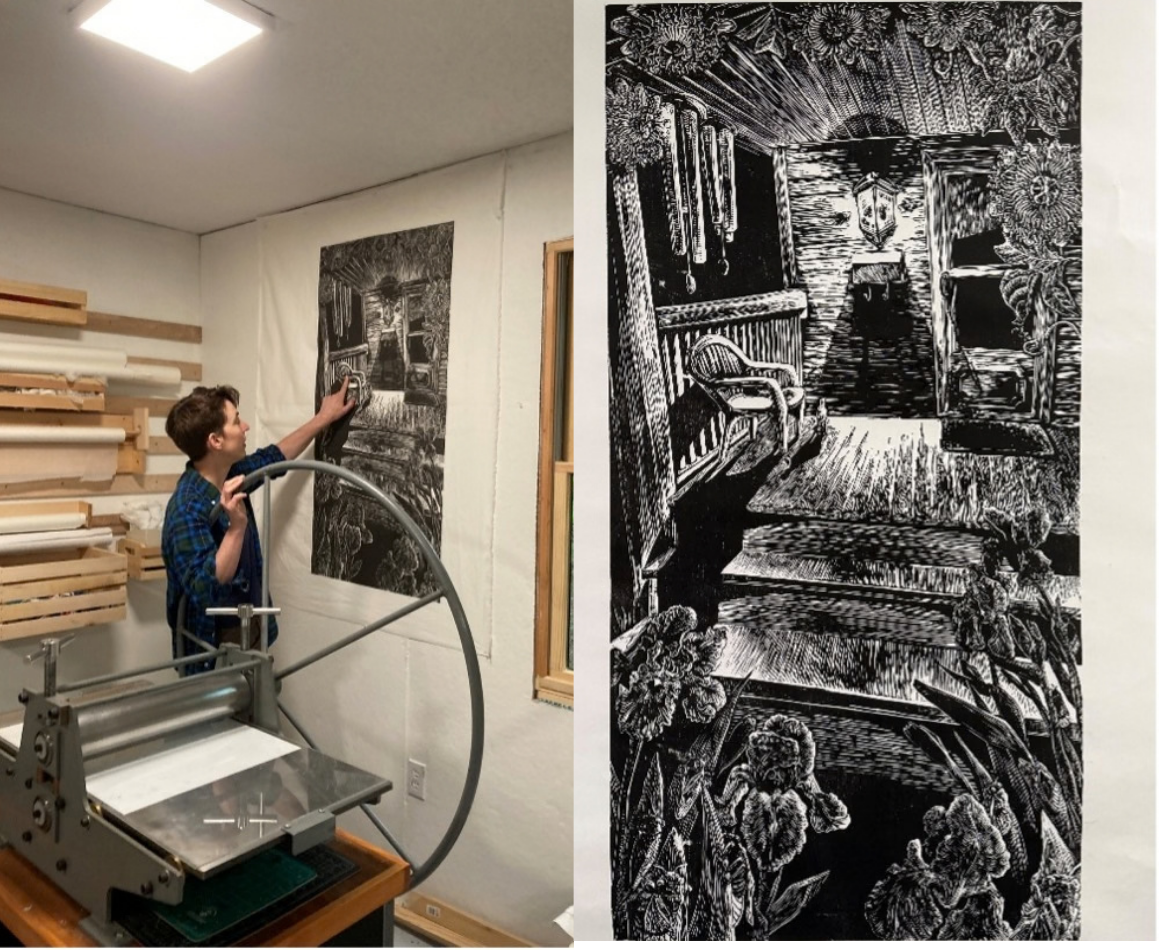
Within the theme of grieving is a print of a porch with an empty chair and wind chimes above. The first-person perspective makes it seem like you are in a dream. You can almost hear the porch steps creak, the swing of the screen door, and imagine the person that once sat in the chair. Erin explains that wind chimes are a common gift in Kentucky when a loved one passes away. She lets out a quiet laugh as she alludes to the absurd number of wind chimes people end up with.
As we move through the studio Erin apologizes for the mess, although it is best as it is – in a creative state like stepping onto a train of thought. She points out the French cleat storage system that Jody Terry, the Joinery’s woodshop librarian of sorts, taught her to make. Jody is one of the more well-known volunteers for she is always busy organizing and devising more efficient solutions to any set of problems. At the Joinery, Jody’s modular system is used to organize and display all kinds of tools and even display items for sale in the gallery. It is easily customizable and can be rearranged as needed. Erin customized her storage system with boxes, shelves, and modules with dowels to store rolls of paper.
At once fascinated by the “Into the Wild” atmosphere and the visceral artwork, my eye is drawn to another piece. It is a triptych illustrating a group of people gathered at a stream playing music together. Erin says this was made for a fellow musician and friend of hers. She made the prints on fabric and built acoustic panels to functionally adorn their guitar shop in Rhode Island.
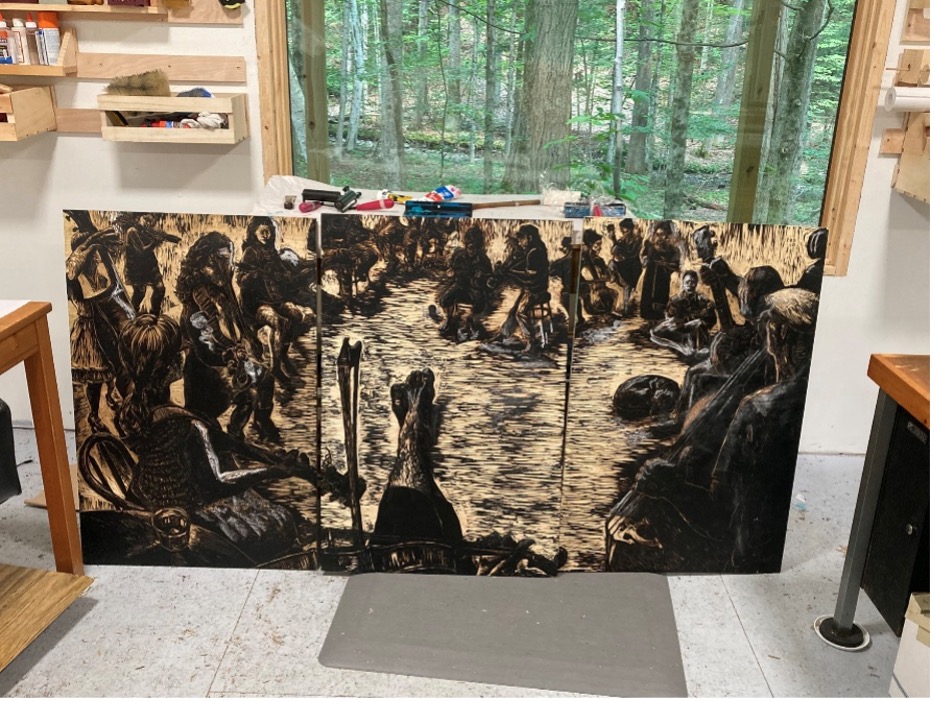
As with all her work, each component of the illustration is very intentional. All the people in the print are people she has played music with in the various places she has called home. You can even find her dog Mabel amongst those gathered. A common feature of her work, the center panel provides a first-person perspective, welcoming the viewer into the scene. It feels as though you are lifted into a part-real, part-imaginary world, reminiscent of Peter Pan’s Neverland.
If Erin’s black ink prints are musical compositions, instrumental in nature, then her layered color prints are the chorus. As someone who so passionately engages with and supports her community, Erin also is motivated to defend it. She has a natural ability to draw from a range of culturally significant subject matter and build a cohesive message people can rally behind.
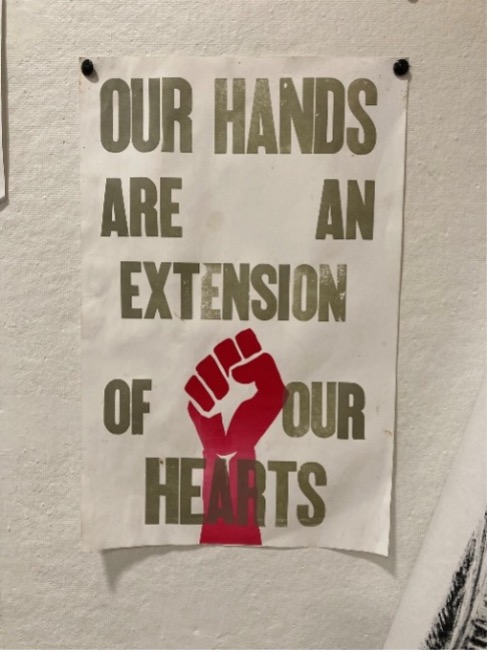
The great benefit of woodblock printing is that once the wood is carved, prints can be made over, and over again. Erin’s designs take on a life of their own. Her vision for a more equitable and autonomous society reverberates with each new print. As she points out, we began to realize during the pandemic that the creation and consumption of art is fundamental to culture. It has the power to unite and the power to heal.
___________________________________________________________________________________
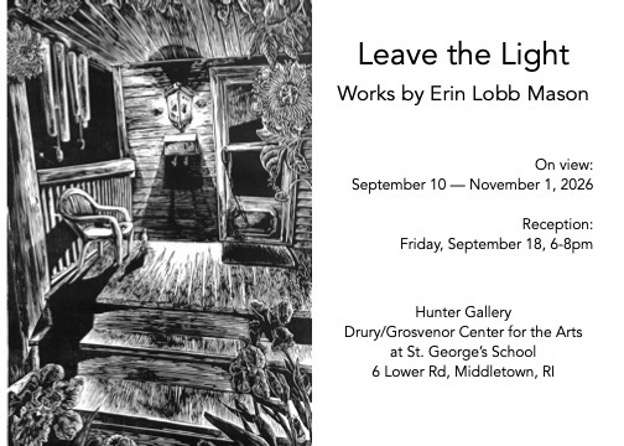
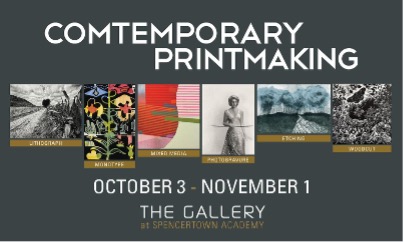
Learn to make your own prints with Erin at Saratoga Arts this fall.
See her portfolio or contact Erin directly via her website.
Bridget Jansen is a designer in Saratoga Springs, New York with over ten years of experience in architectural design and design-build settings. She is an advocate for community-based building arts and emphasizes the home as a means for personal expression. Read more from Bridget here.


Saratoga Joinery is a 501(c)(3) nonprofit organization and relies upon the support of the community to keep our blades spinning.